How Does the Instagram Algorithm Work?
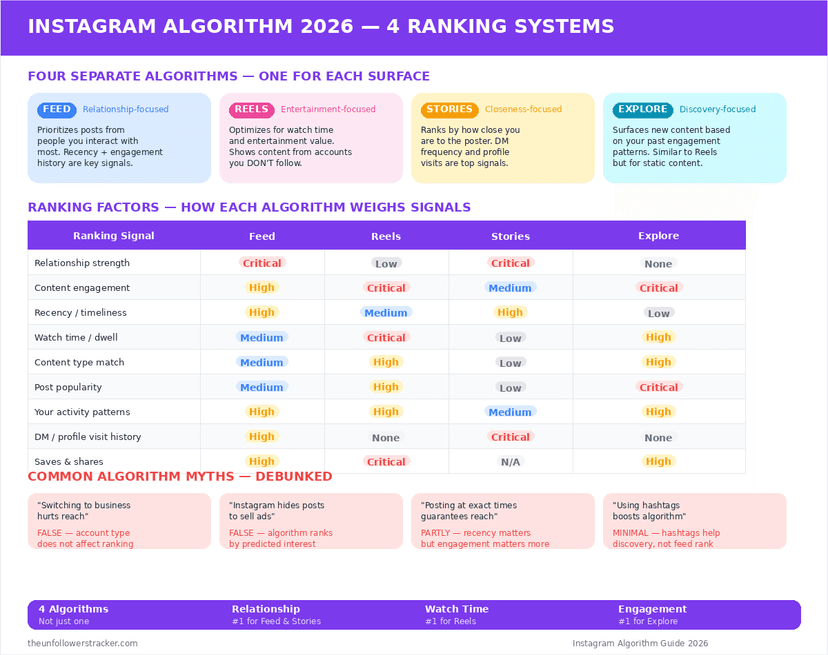
There is no single Instagram algorithm. Feed, Stories, Reels and Explore each rank with their own model, and Instagram's head Adam Mosseri named the 3 signals that carry most weight in January 2025: watch time, likes per reach and sends per reach.
The newer part is that some of it is now editable. Since December 2025 Instagram has been rolling out a screen called Your Algorithm, which shows the topics it thinks you want and lets you turn them down — the first time the ranking has been open to the person being ranked.
Is there one Instagram algorithm?
No, and treating it as one is why advice about it contradicts itself. Each surface answers a different question, so the same post can do well in 1 place and nowhere else.
| Surface | The question it answers | What it leans on |
|---|---|---|
| Feed | What did the people you follow post | Your history with that account |
| Stories | Who do you actually talk to | Closeness signals |
| Reels | What will hold a stranger's attention | Watch time and replays |
| Explore | What is new that you might like | Sends, saves, topic match |
| Search | What matches these words | Text, not behaviour |
Feed and Stories rank people you already chose. Reels and Explore rank strangers, which is why one Instagram algorithm cannot describe both, and why the same post behaves differently in each — and why the Explore model gets its own page.
Which signals matter most?
The 3 Mosseri named, and they are not equally weighted everywhere. Watch time counts total seconds and replays rather than a view. Likes per reach measures approval among people who saw it. Sends per reach counts shares into DMs.
The weighting splits by audience. Sends matter more for content shown to people who do not follow you, because a share is the strongest evidence a stranger found it worth passing on. Likes matter more for content shown to your own followers.
Note that all 3 are ratios. A post seen by 500 people with 50 sends outranks one seen by 50,000 with 100, which is why small accounts are not structurally disadvantaged in recommendations.
What changed in 2026?
Two things worth knowing. Instagram extended its originality rules from Reels to photos and carousels in April 2026: an account that mostly posts content it did not create stops being eligible for recommendation to non-followers, though it still reaches its own followers.
The second is Your Algorithm, which arrived for Reels in the US on 10 December 2025, reached Explore in April 2026, and began rolling out to the main feed in June 2026. It lists the topics Instagram has inferred about you and lets you switch them off.
Step 1: Open Your Algorithm
The entry point moved during the rollout, so check both places. In Reels, open the share sheet or the three-dot menu on a Reel and look for Your Algorithm.
If it is not there, open Settings and search for "algorithm". A US account is likely to see it before others, and the main-feed version is still reaching people.
Step 2: Turn down the topics you did not choose
The screen lists inferred interests as plain labels — the kind of thing that reads as "Skincare" or "AI tools" — with controls to see more or less of each.
Turn down what is wrong rather than everything you dislike. The topics are how Instagram groups content, so switching off a broad one removes more than the posts that annoyed you.
Step 3: Give it a week before judging
The Instagram algorithm responds to accumulated behaviour rather than to a single setting, so a feed does not change the moment you leave the screen.
Watch what appears over 7 days. If a topic you turned off keeps returning, your own taps are re-teaching it — the models weight what you do above what you say.
Does losing followers hurt your ranking?
Not directly. Reach follows engagement rate, and an account that never engaged was lowering that rate while it stayed. Losing it can leave your ranking unchanged or slightly better.
The follower count itself is not a ranking signal on any surface. What the follower change tells you is about your content, and that chain is set out in how unfollows affect your reach.
Knowing how ranking works settles nothing on its own. The decisions it should inform — audience, subject, and a reason for anybody to forward a post — are in six questions to answer before your next post.
FAQ
The 5 questions below cover what the algorithm ranks, what it ignores, and what you can change. All answers reflect Instagram's stated behaviour in September 2026.
How does the Instagram feed algorithm work?
It ranks posts from accounts you follow by predicting your interest, using your history with each account and the post's own signals. It is a different model from the one behind Reels or Explore.
What are Instagram's main ranking signals?
Watch time, likes per reach and sends per reach, named by Adam Mosseri in January 2025. Sends weigh more for reaching non-followers; likes weigh more for reaching your own followers.
Does the Instagram algorithm favour Reels over photos?
Not by format. Reels reach non-followers more readily because recommendations lean on watch time, which video produces and a photo does not.
Can I control the Instagram algorithm?
Partly, through Your Algorithm — the topic controls that reached Reels in December 2025 and the main feed in June 2026. It adjusts recommendations, not posts from accounts you follow.
Does posting more often improve ranking?
No. Frequency is not a signal; the ratios are. Posting more only helps if the extra posts hold attention as well as the others.

Track Your Instagram Unfollowers
Discover who stopped following you and optimize your growth strategy with our free tool.
Discover Unfollowers