Instagram Algorithm Myths: Do Unfollows Hurt Your Reach?

No — unfollows do not reduce your reach. Instagram looks at each post on its own: watch time, DM shares, and likes decide how far it spreads. Losing a follower removes one viewer, not your algorithmic standing. Your next Reel gets the same shot at reach whether you lost five followers yesterday or gained fifty.

People mix up two different things. Having fewer followers means a smaller viewer pool. That's math. Being punished by the algorithm? That doesn't happen.

These are the most common instagram algorithm myths in 2026 — and what the instagram ranking signals show instead.

There Is No Single "Instagram Algorithm"

This is the root cause behind most instagram algorithm myths.

Instagram runs separate ranking systems for Feed, Stories, Reels, Explore, and Search. Each surface has its own model with different weights. A post that flops in Feed can still take off on Explore. A Reel buried on your grid can rack up millions of views through Explore.

Adam Mosseri has said this many times: what works on one surface may not work on another because they are different systems. When someone says they've "cracked the algorithm," ask which one. Understanding instagram algorithm how it works means understanding there are five of them.

The Three Instagram Ranking Signals That Control Your Reach in 2026

Mosseri named three signals that carry the most weight across surfaces:

  1. Watch time — how long people spend on your content
  2. Sends per reach — how many people DM-share your post relative to impressions
  3. Likes per reach — the ratio of likes to total views

Sends per reach is the strongest trigger for instagram reach 2026. If people share your post in DMs, Instagram reads that as a quality signal and pushes it into Explore and Reels feeds. This matters more than comments, saves, or follower count.

Notice what's missing: follower count. Not top three. Not close.

Myth vs. Reality: 7 Instagram Algorithm Myths Debunked

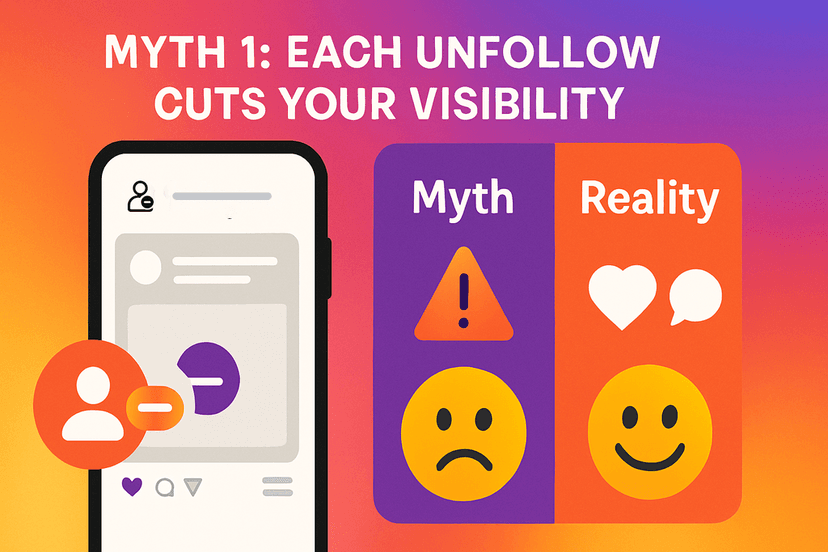
Myth #1: Losing Followers Tanks Your Reach

Reality: Does losing followers hurt instagram performance? No. Instagram does not penalize you for unfollows. Each post stands on its own — the initial reaction determines spread, not your follower trend.

Losing 1-2% per month is normal. People leave the app. They lose interest. Bots get purged. Understanding why people unfollow on Instagram helps separate normal churn from real problems. HubSpot data shows inactivity causes 44% of follower loss — nearly half of all unfollows happen because someone stopped using Instagram.

A slow trickle is fine. A sudden spike is different. Losing 5%+ in a week could mean bot traffic or a content shift that alienated your core audience. Retention above 90% over 30 days is strong. Below 80% means a churn problem. Tools like Unfollowers Tracker help you see who left and when, so you spot patterns instead of guessing.

each unfollow cuts your visibility

Myth #2: Your Previous Post Performance Drags Down Future Posts

Reality: This is wrong. Instagram's Chiru Weinstein directly addressed this myth, confirming that each piece of content is evaluated independently. A post that gets 200 views does not doom your next post to 200 views.

This myth sticks around because creators experience streaks — a few bad posts in a row — and assume they've been suppressed. The real cause is usually simpler: inconsistent timing, a dip in quality, or a topic that didn't land.

Correlation is not causation. Especially when the platform itself says the mechanism doesn't work that way.

Myth #3: Business and Creator Accounts Get Less Reach Than Personal Accounts

Reality: Account type does not affect ranking. Mosseri has stated this plainly. Instagram does not suppress business or creator accounts to push them toward paid advertising.

This myth likely started because business accounts began tracking analytics for the first time and found their reach was lower than assumed. Seeing real numbers is humbling. Switching back to a personal account won't change them — you'll lose the ability to see them.

Myth #4: Scheduling Posts Kills Your Engagement

Reality: Mosseri debunked this one directly. Scheduling through Instagram's built-in tools or Meta Business Suite does not reduce distribution. The platform treats scheduled posts identically to manually published ones.

Third-party scheduling tools are a different, murkier question. There's no confirmed penalty, but some creators report marginally lower reach. The more likely explanation: third-party tools sometimes strip metadata or alter image quality during upload. If you're concerned, use Instagram's native scheduler.

Myth #5: Follower Count Determines Reach

Reality: Does losing followers hurt instagram reach? No. Follower count is no longer a strong predictor of reach. Small accounts with high engagement beat large accounts with passive audiences all the time. Instagram cares about how the people who see your content react to it — not how many people could see it.

A 5K food account where every post gets saved and shared in DMs will reach more non-followers than a 500K meme page with a 0.3% instagram engagement rate. Reach is earned per-post, not rented through follower numbers.

Myth #6: Hashtags Are the Key to Discovery

Reality: Hashtags are not dead, but they are no longer a primary discovery mechanism. Instagram's recommendation engine — the system behind Explore and suggested Reels — has largely replaced hashtag-based discovery.

Using 20-30 hashtags doesn't hurt you, but it won't rescue weak content either. Instagram now uses AI to understand what your post is about visually and textually. Two or three specific hashtags can still help categorize your content. But if your strategy depends on hashtag research, you're working on the wrong thing. Spend that time making content people want to send to friends.

Myth #7: Posting Frequently Gets You Shadowbanned

Reality: There's no evidence that high posting frequency triggers suppression. What does happen: if you post five times a day and each post gets negligible engagement, your per-post average drops. That's not a penalty — it's dilution. Your audience has a finite attention budget.

Mosseri's data points the opposite way for one format: creators who post Stories often see fewer unfollows. Stories keep you top-of-mind — one of the simplest ways to stop losing followers without cluttering the main feed. Two feed posts per week plus daily Stories works for most creators. The right pace depends on your audience and what you can sustain.

What Does Affect Reach? The Real Unfollow Impact on Instagram

So do unfollows affect reach? Not directly. But these things do — and they're the real culprits when reach drops:

Low watch time on Reels. If viewers swipe away in the first second, Instagram stops distributing. The first frame matters more than the last.

No DM shares. Content that gets likes but never gets sent in DMs has a ceiling. Sends per reach is the top signal for new audience reach — without it, you stay inside your follower bubble.

Posting only static images. Reels engagement averages 3.8%, roughly 3-5x higher than static image posts. The average overall Instagram engagement rate sits at 1.22%. If you're posting nothing but single-image posts, you're competing in the lowest-distribution format on the platform.

Engagement-bait tactics. "Double-tap if you agree" and "Comment YES for the link" used to work. Instagram now detects and suppresses engagement bait. Genuine interaction beats manufactured interaction every time.

Inconsistency. Not posting frequency, but regularity. Going silent for three weeks and then dumping four posts in a day sends confusing signals to your audience and gives the ranking system less data to work with. A predictable rhythm — even a slow one — outperforms erratic bursts.

What Unfollows Actually Tell You

Unfollows aren't an algorithm problem. They're a content-market fit problem.

When someone unfollows you, they're giving you data. The question is whether you're paying attention to it. A steady, low-rate trickle (1-2% per month) is background noise. A spike after changing content formats, topics, or tone is a signal. A burst of unfollows right after a promotional post tells you something different than a burst after a controversial take.

The value isn't in preventing unfollows — you can't control other people's decisions. The value is in understanding why they happen so you can make informed choices about your content direction.

instagram reach what really works 2026

Engagement Benchmarks That Actually Matter in 2026

Stop comparing your instagram engagement rate to accounts in different niches with different audience sizes. Here are the numbers that matter for instagram reach 2026:

The overall average instagram engagement rate is 1.22% across all formats and account sizes. Reels average 3.8% — the highest of any format. Healthy follower retention sits at 90%+ over 30 days. Below 80% suggests follow-churn or bot traffic. Normal monthly follower loss is 1-2% for established accounts.

If your rate is below 1%, look at your content mix first. Above 2% means you're beating the platform average regardless of follower count.

F.A.Q.

Do unfollows affect your Instagram reach?

No. Instagram does not penalize your account or reduce your reach because someone unfollowed you. Each post is ranked independently based on engagement signals like watch time, DM shares, and likes. Losing a follower shrinks your potential audience by one person, but it triggers no algorithmic suppression.

How does the Instagram algorithm work in 2026?

Instagram runs separate ranking systems for Feed, Stories, Reels, Explore, and Search — there is no single algorithm. The top three ranking signals across surfaces are watch time, sends per reach (DM shares), and likes per reach. Content that gets shared in direct messages receives the strongest distribution boost to new audiences.

Does switching to a business account reduce Instagram reach?

No. Adam Mosseri has confirmed that account type (personal, creator, or business) does not affect how Instagram ranks or distributes your content. Business accounts see the same algorithmic treatment as personal accounts.

What is a good engagement rate on Instagram in 2026?

The overall average Instagram engagement rate is 1.22% across all formats and account sizes. Reels average significantly higher at 3.8%. An engagement rate above 2% is above-average, and rates above 5% are exceptional. Engagement varies heavily by niche, so compare within your category rather than to global averages.

Does scheduling Instagram posts hurt engagement?

No. Mosseri debunked this myth directly. Posts scheduled through Instagram's native tools or Meta Business Suite receive the same algorithmic treatment as manually published posts. There is no reach penalty for scheduling.

How many followers is it normal to lose per month?

Losing 1-2% of your followers monthly is normal for established Instagram accounts. Inactivity accounts for 44% of all follower loss — people simply stop using the app. A follower retention rate above 90% over 30 days is excellent. If you're losing more than 20% of new followers within a month, investigate whether you're attracting follow-and-unfollow bot traffic.

Bottom Line on Instagram Algorithm Myths

Do unfollows affect reach? No. The unfollow impact on instagram is zero in terms of algorithmic penalty. Instagram watches how people react to each post — watch time, likes, and DM shares — not your follower trend.

If your reach is dropping, the cause is almost never "I lost too many followers." It's almost always "my content isn't generating the signals that trigger distribution." Fix the content. The reach follows.

Track Your Instagram Unfollowers

Discover who stopped following you and optimize your growth strategy with our free tool.

Discover Unfollowers

We use cookies. Policy